Putin is skiing and discussion with Pavla Dombrovská and Milada Boráros
PUTYIN SÍEL – Putin is skiing / a play about the birth of a killer/ in Hungary on festival MonoBáb v Szombathely
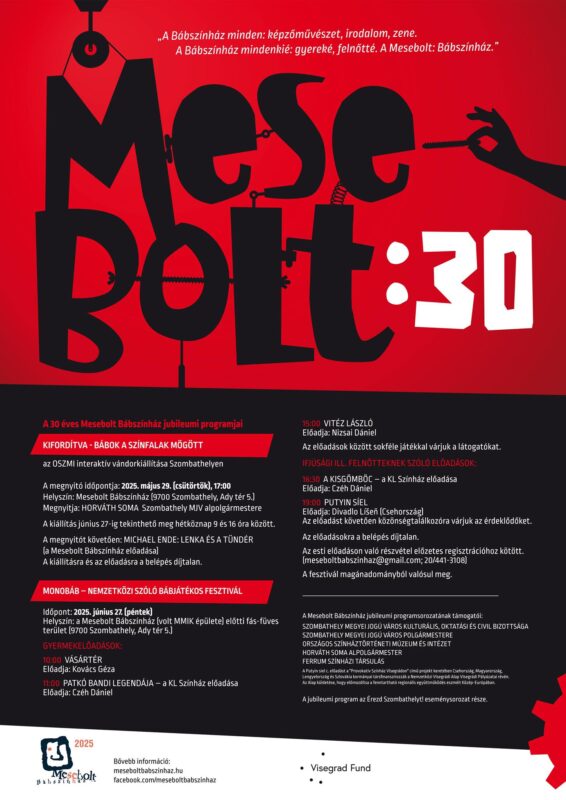
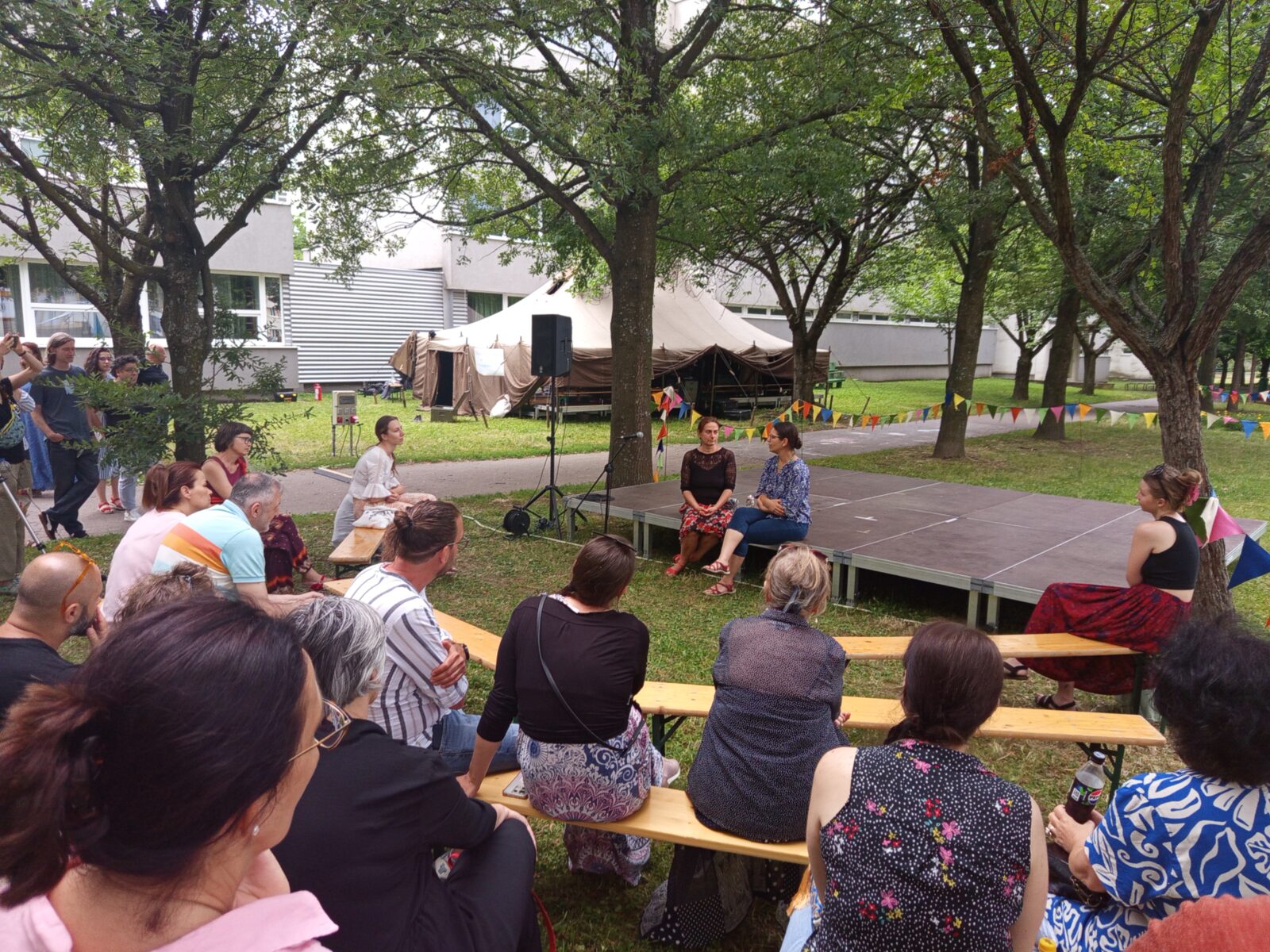
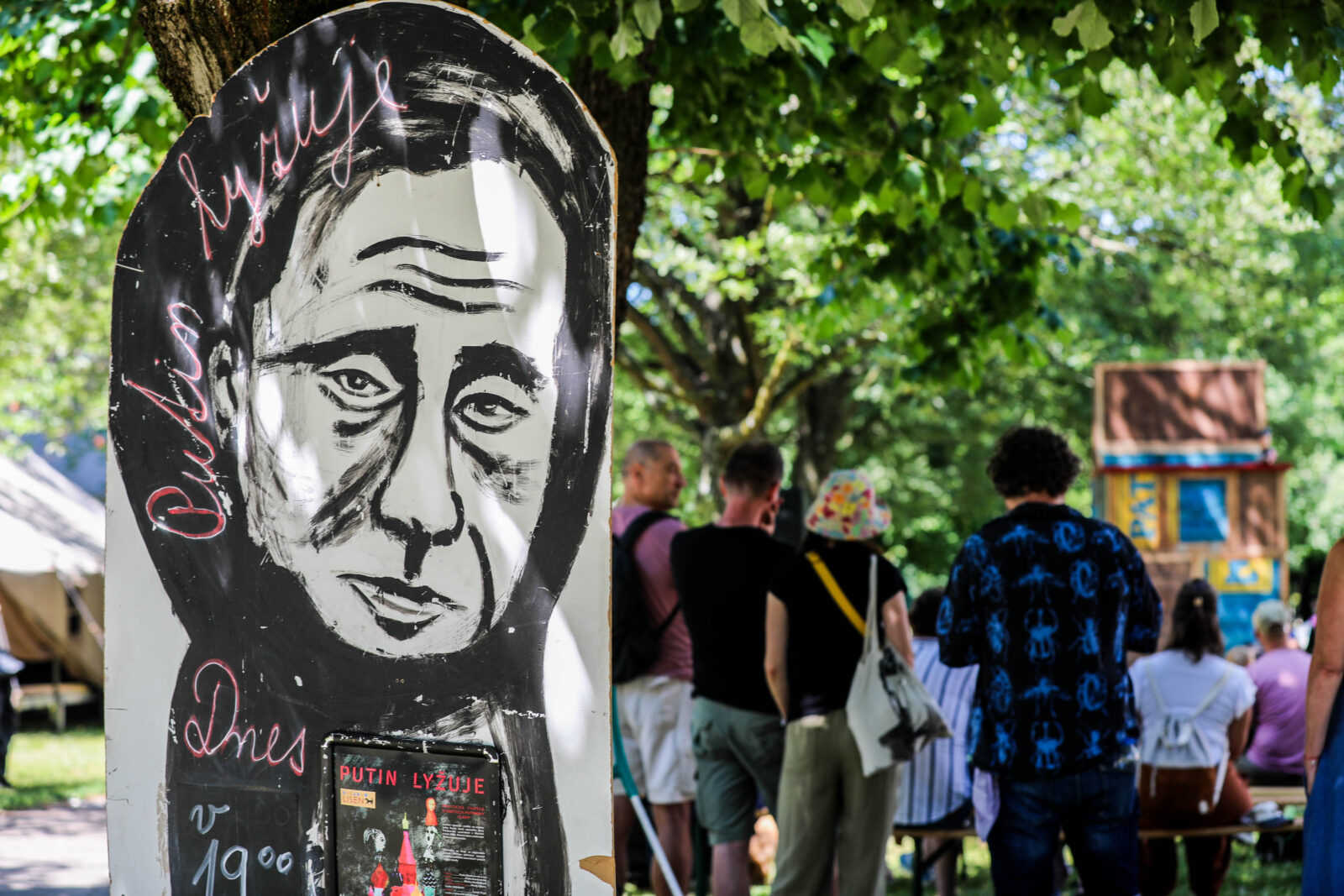
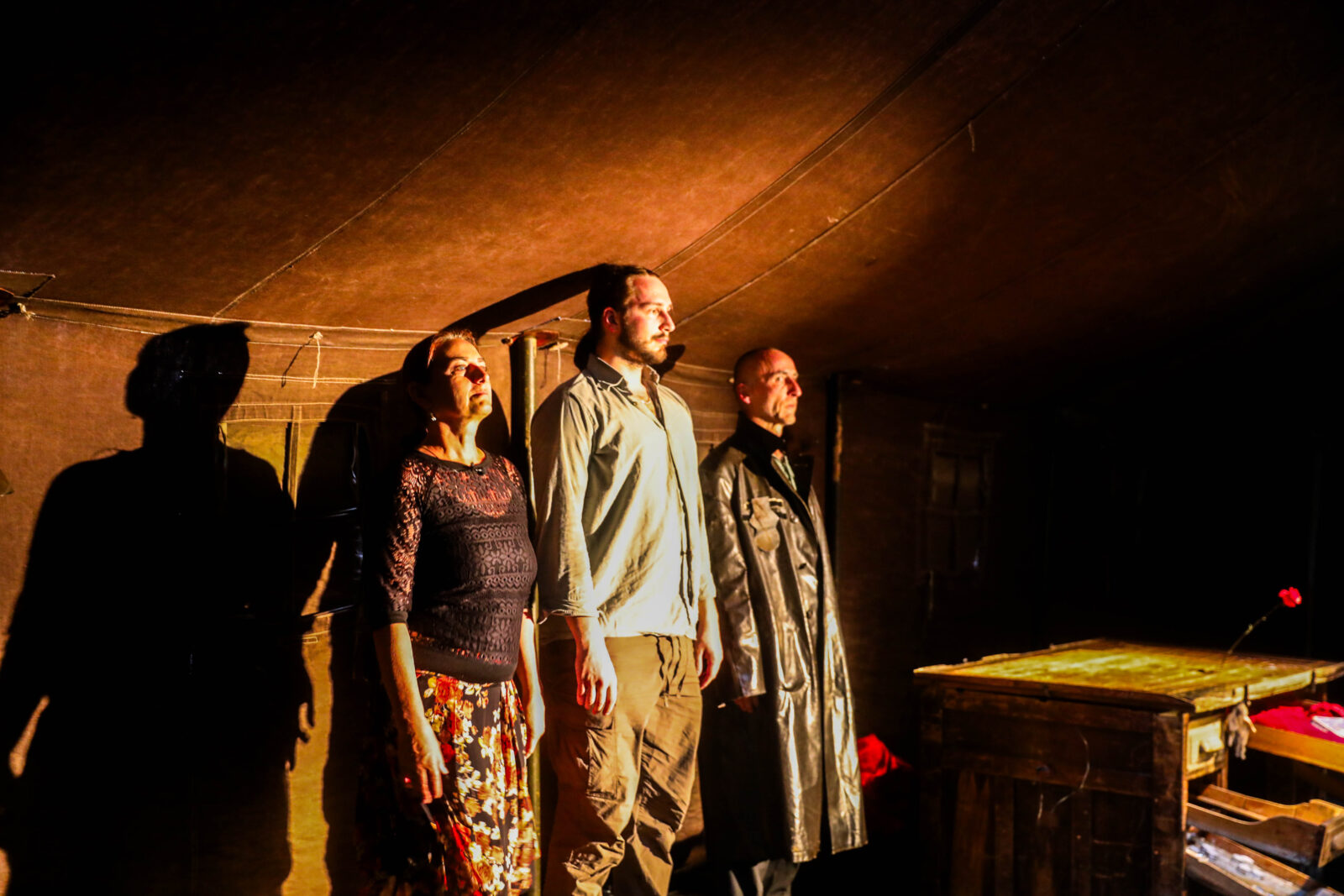
Divadlo Líšeň performed the play Putin is Skiing with Hungarian subtitles in a small park next to the theatre, followed by a post-performance discussion with the audience led by Pavla Dombrovská and Milada Boráros.
In the post-Soviet space, the meaning of the play Putin is Skiing /a play about the birth of a killer/ has changed significantly over time, and “unfortunately,” even after fifteen years, the production has not lost its relevance. In the subsequent discussions with audiences, the need for personal sharing of common fears and hopes has been growing. Over the years, we have observed both disturbing and hopeful developments in individual countries that share a history of Soviet occupation.
For example, in Slovakia this spring, despite a full house and an enthusiastic audience in Žilina (Stanica Žilina–Zárečie), the event resulted in the courageous producer’s social media profile being blocked. An additional sense of unease was caused by the cancellation of a morning performance for schools. The school administration became afraid and simply cancelled both the performance and the discussion.
By contrast, in Hungary—where we have already performed twice since the beginning of the year (first in April in Zalaegerszeg with Hygiene of Blood)—it was encouraging to observe a growing interest in public affairs and politics. It feels as though, alongside the rising popularity of the opposition movement led by Péter Magyar, the chance for change after fifteen seemingly endless years of Viktor Orbán’s rule has also increased. At the end of June, we returned to Hungary, this time with Putin is Skiing, which we presented at a festival in Szombathely.
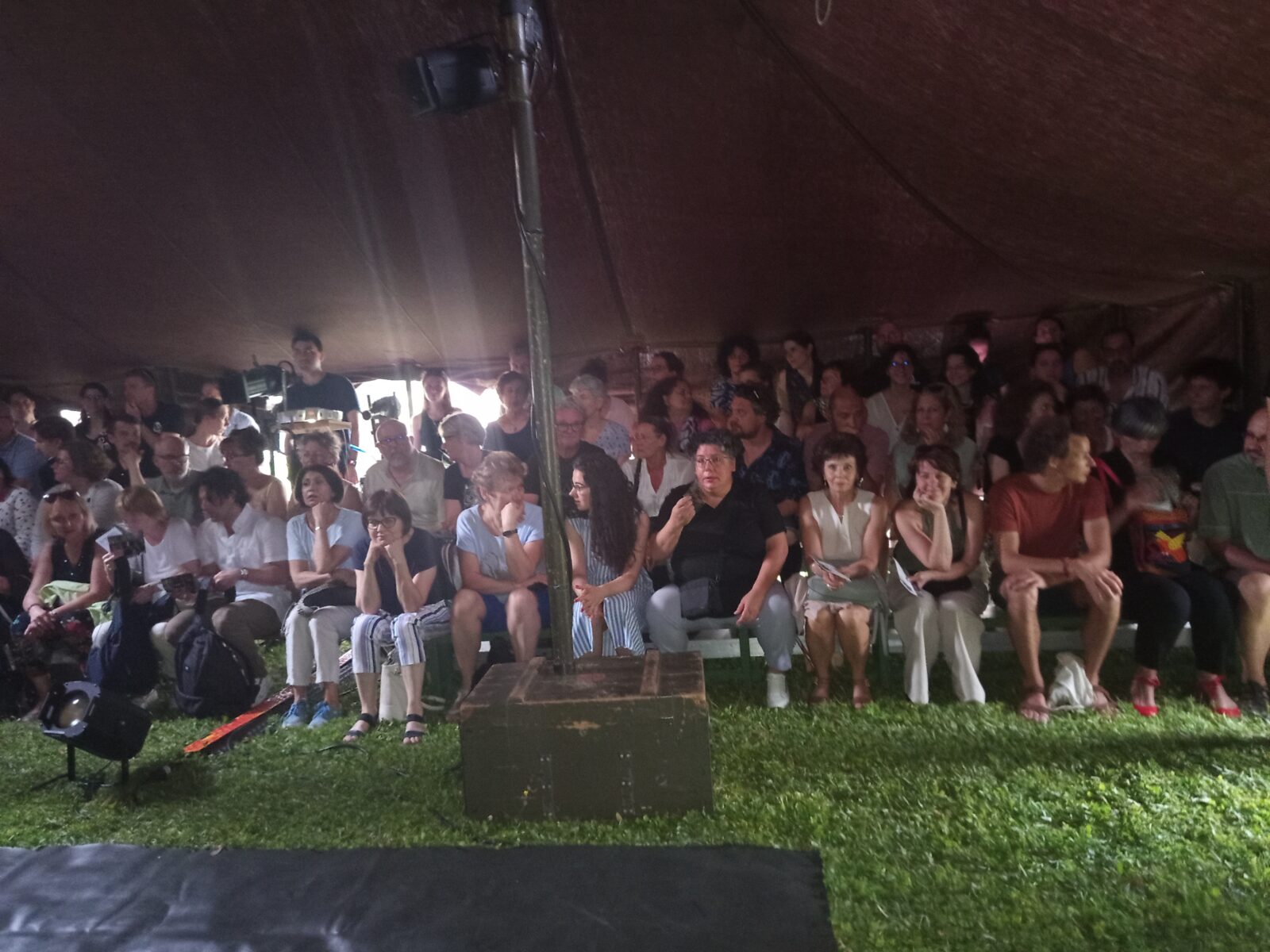
I would like to thank Lívia Ölbei for her review, which precisely captures both the meaning and the details of the play—despite the fact that performing in a tent that, in thirty-degree heat, resembled an aquarium was a physically extreme experience for both the actors and the audience.
“… Lyricism, tragedy, grotesque, absurdity
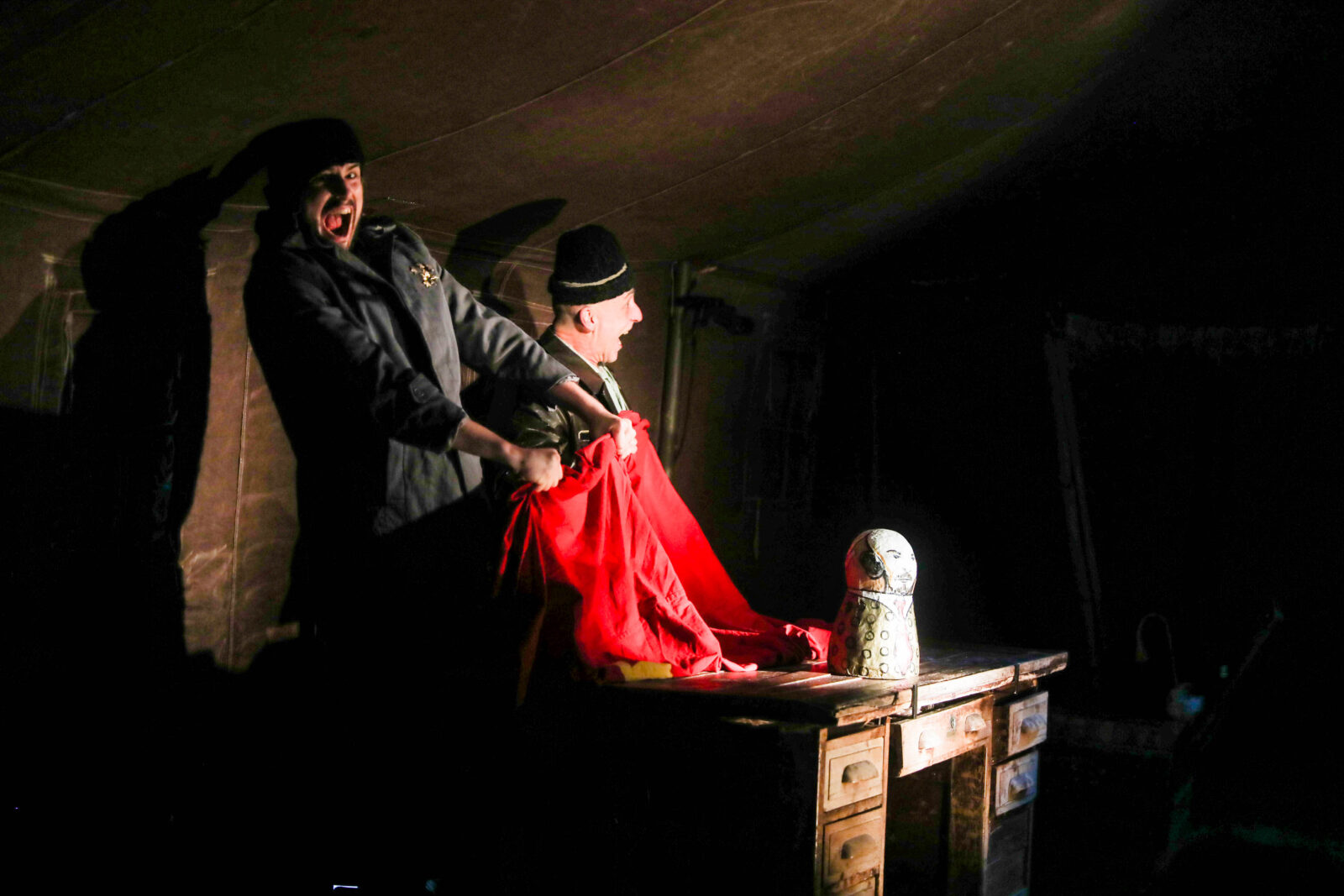
In Putin is Skiing, lyricism, tragedy, grotesque elements, and absurdity intertwine. When Putin skis (because he “certainly skis” whenever there is a reason for him not to appear in public) on the tilted surface of a table that instantly turns into a ski slope, the audience experiences an emotional roller coaster—also thanks to music based on Russian and Chechen folklore. Within a single hour, laughter alternates with tears.
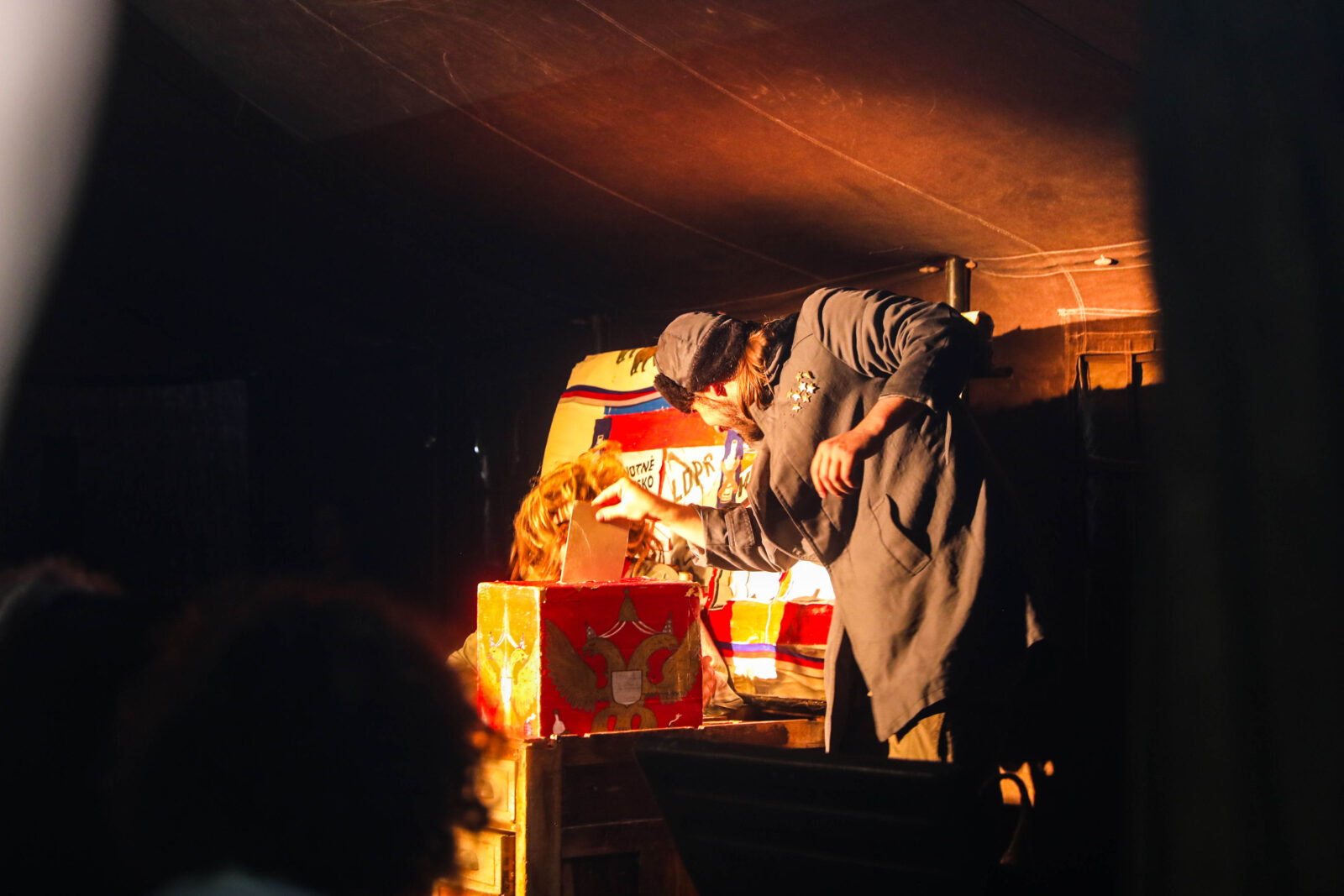
The deeper the story descends, the more astonishing the cabaret scenes, acting, and the work with puppets and objects become. A few examples: how stylized flat puppets (the victims) turn into medals and are pinned onto a uniform—exclusively over the heart; how fingers transform into functional legs, and then suddenly into spider-like limbs that are both ridiculous and terrifying; or how, at the very end, a red rose suddenly appears from the drawer of the desk—from which Putin’s Labrador had previously emerged—as a memorial to the victims…
… In the finale of the production, Pavla Dombrovská sings (Chorny Voron / Black Raven), a legendary Russian folk song that has been interpreted many times. Her voice sounds as if rural women from previous centuries were speaking—yet it resonates here and now.”
We are attaching the complete translation of the review.
After the performance, a discussion followed—this time with me. We talked for a long time, hardly noticing that darkness had fallen. We are also attaching the discussion transcript translated by Milada Boráros.
I would like to thank Milada Boráros for all her support, for translating the script of the production into Hungarian, and for interpreting the discussion.
We also thank Kata Csató, director of Mesebolt Puppet Theatre, for the invitation, and the entire festival organizing team for their warm welcome and comprehensive support.
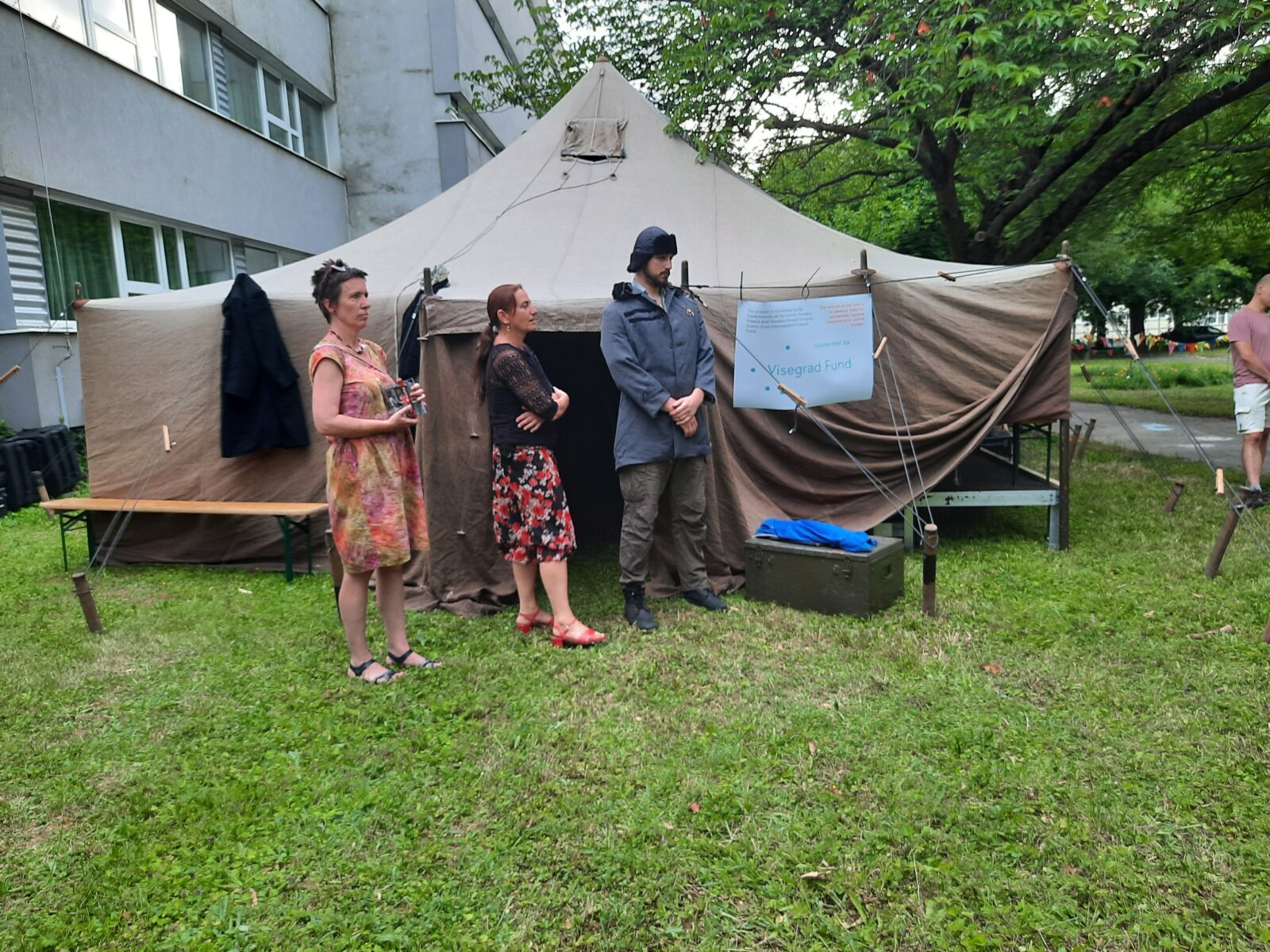
The event was made possible thanks to the support of the Visegrad Fund.
Pavla Dombrovská
Russian Diary: A Bonus from the Czech Republic at the First MonoBáb Festival Organized by Mesebolt Theatre in Szombathely
Lívia Ölbei | June 29, 2025
www.artlimes.hu
The closing performance of the first MonoBáb Festival in Szombathely, organized by the Mesebolt Puppet Theatre celebrating its 30th anniversary, was a true bonus—not only because it was the only production with multiple performers. Divadlo Líšeň (Czech Republic, Brno-Líšeň) presented Putin is Skiing, a production for adult audiences. Putin is Skiing—and the audience feels like they are on a roller coaster.
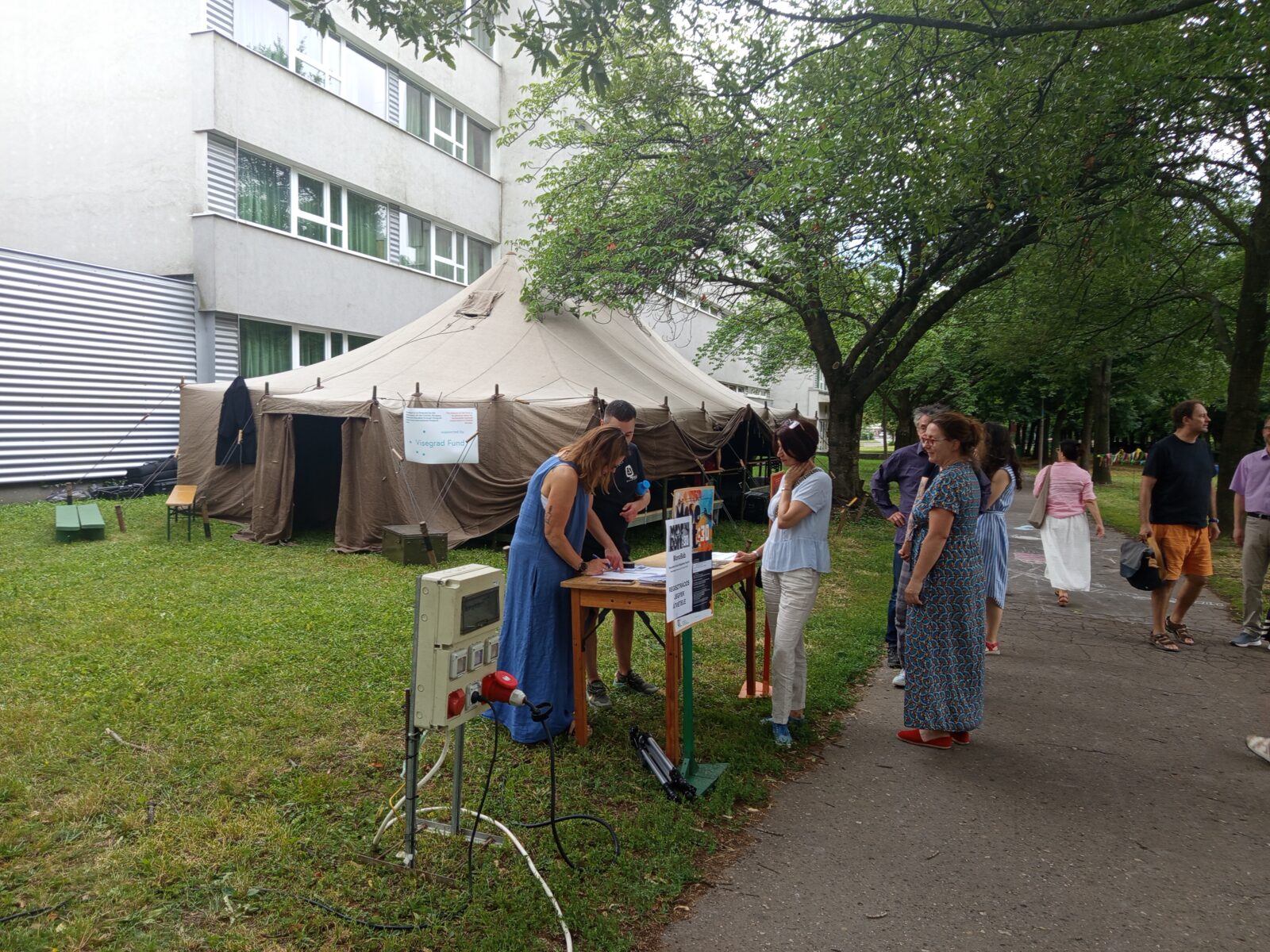
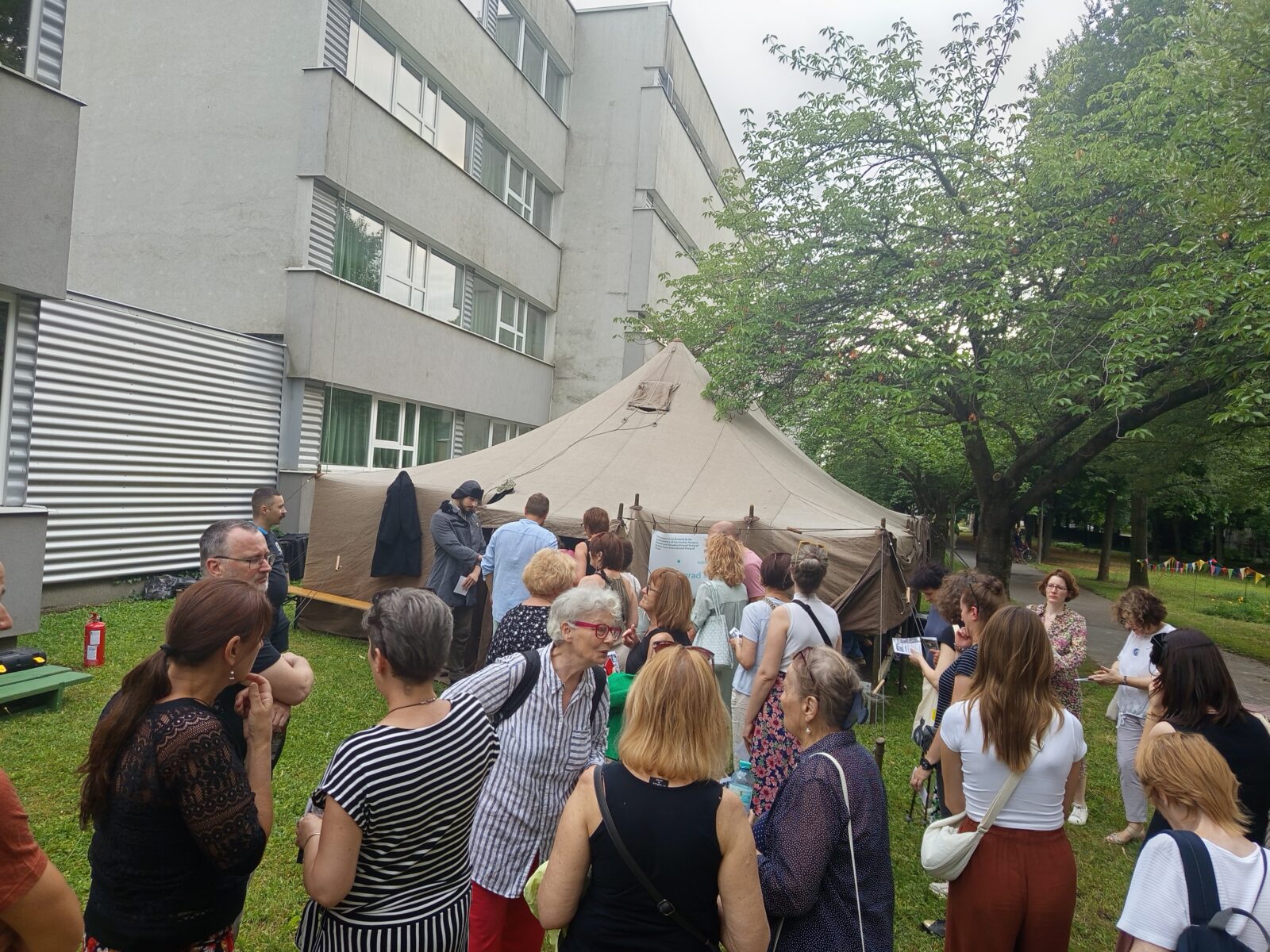
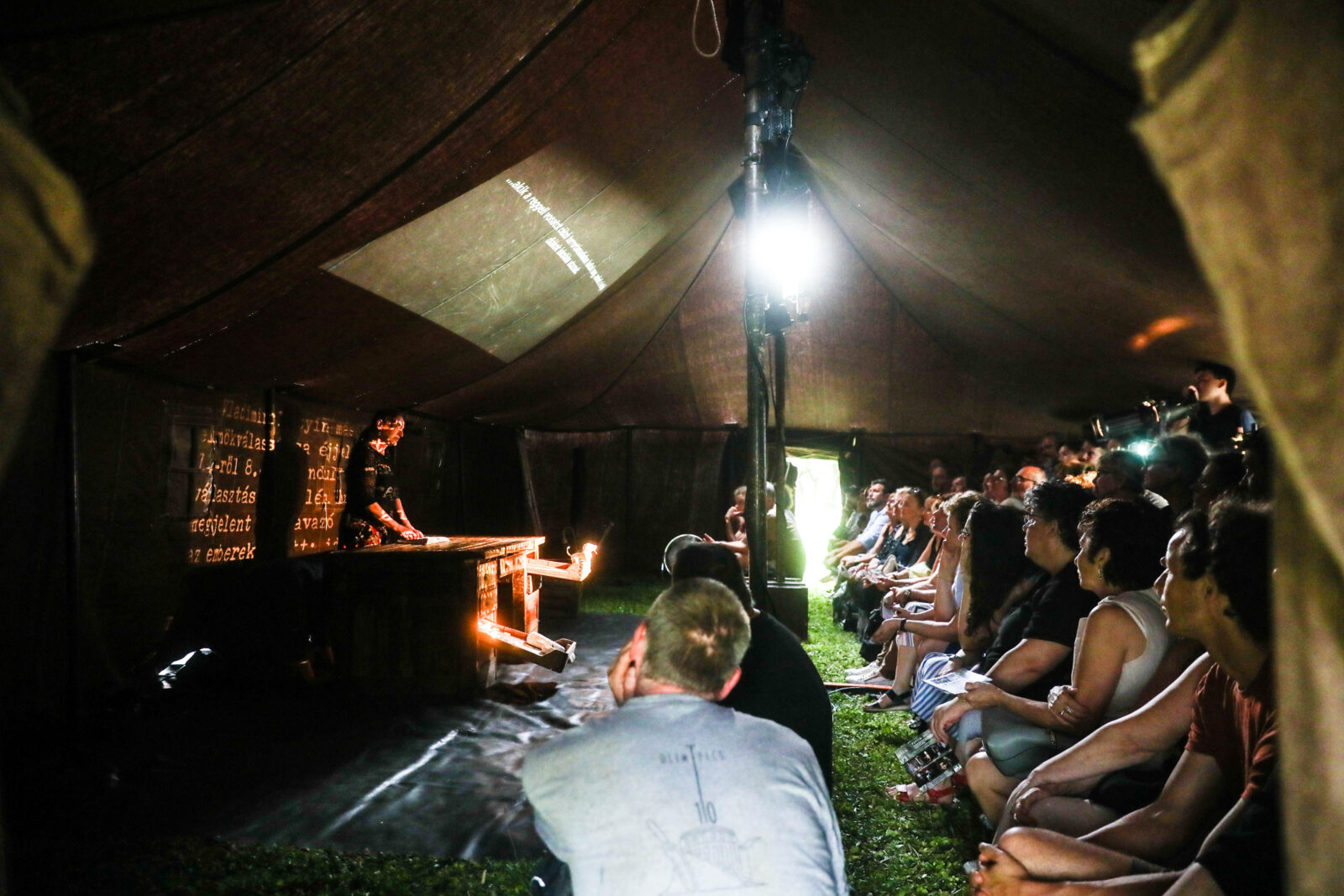
At 7 p.m., it finally becomes clear what the military tent erected on the lawn behind the festival promenade is for: it hosts Putin Goes Skiing by Brno-based Divadlo Líšeň. This adult production, touring the V4 countries as part of the Provocative Theatre project supported by the International Visegrad Fund, completely filled the improvised auditorium of benches seating 90–100 spectators. Two performances could easily have been sold out. This “bonus”—a multi-character production—closed the MonoBáb Festival. Kata Csató, director of Mesebolt Puppet Theatre, said farewell by announcing that the ensemble has been invited back next year. Those who missed it this year may hope to see it in 2026.
For now, however, we enter the tent, which feels like an aquarium made of matte, opalescent fabric. Measuring 10 × 8 × 3.6 meters, it already creates a sense of confinement.
Politkovskaya and the documentary layer
Russian journalist Anna Politkovskaya (1954–2006), murdered on Putin’s birthday, has several books translated into Hungarian. Russian Diary, which investigatively traces how Putin built his totalitarian power—with particular attention to the Moscow Dubrovka Theatre hostage crisis, the Chechen war, and the Beslan school siege—was published in Hungarian by Athenaeum in 2018, translated by Ádám Szieberth. Reading it was a revelation, partly because of the unsettling familiarity of the events.
Pavla Dombrovská, artistic director of Divadlo Líšeň and co-founder of the company together with her life partner Luděk Vémola, created the script based on Russian Diary and also performs the reading herself. Her narration is factual, journalistically precise, passionate, and powerful, supported by projected data. This documentary layer is one of the levels of the production, which she describes as a “political grotesque.”
Outstanding puppet theatre
The second layer is extraordinary puppetry combined with live acting. The dialogues appear in Hungarian translation in the background. The stage is an old, worn writing desk full of drawers and compartments, offering countless functions. During the subsequent discussion—sparked by the audience’s unceasing questions—Pavla Dombrovská revealed that the desk is a found object, rescued from a friend’s balcony (with interpretation by Milada Boráros).
The performance is puppet theatre in the original sense of the word—a family theatre. Luděk Vémola and Štěpán Vémola (the son of Luděk and Pavla) are two phenomenal puppeteers. Štěpán quite literally grew up in this production (his role had previously been played by two other actors).
Lyricism, tragedy, grotesque, absurdity
In Putin is Skiing, lyricism, tragedy, grotesque elements, and absurdity intertwine. When Putin skis—because he “certainly skis” whenever he has a reason not to appear in public—on the tilted tabletop turned into a ski slope, the audience embarks on an emotional roller coaster, aided by music based on Russian and Chechen folklore. Within a single hour, laughter alternates with tears.
The deeper the story descends, the more astonishing the cabaret scenes, acting, and work with puppets and objects become. For example: stylized flat puppets (the victims) transform into medals pinned onto a uniform—always over the heart; fingers turn into functional legs and then suddenly into spider-like limbs that are both comical and terrifying; or, at the end, a red rose suddenly appears from the drawer of the desk—from which Putin’s Labrador had previously run out—as a memorial to the victims.
The beginning of Russian Diary
Russian Diary by Anna Politkovskaya begins (Part I: The Death of Russian Parliamentarianism):
“December 7, 2003. Parliamentary election day, and the day President Putin launches his campaign for re-election. In the morning, he appeared before the Russian people at a polling station. He was in a good—almost elated—mood and looked somewhat nervous. That was unusual, as he usually wears a scowl. This time, however, he announced with a broad smile that his beloved Labrador, Connie, had given birth to puppies during the night. Vladimir Vladimirovich was very worried!” chirped Mrs. Putin, standing behind her husband. “We’re rushing home,” she added. They rushed to the dog, who had timed the birth with perfect political precision—as a gift to the United Russia party.”
The diary follows events from December 2003 to August 2005.
Updates and conclusion
Divadlo Líšeň has been performing this production for fifteen years. Today, it also incorporates information about the invasion of Ukraine—because Anna would certainly have gone there and reported from the scene.
In the finale, Pavla Dombrovská sings (Chorny Voron / Black Raven), a legendary Russian folk song that has been interpreted many times. Her voice sounds as if rural women from past centuries were speaking—yet it resonates unmistakably here and now.
Milada Boráros is a member of the Magamura Creative Workshop (Magamura Alkotóműhely) in Hungary. She collaborates with puppet theatres as a set designer, dramaturg and director.